


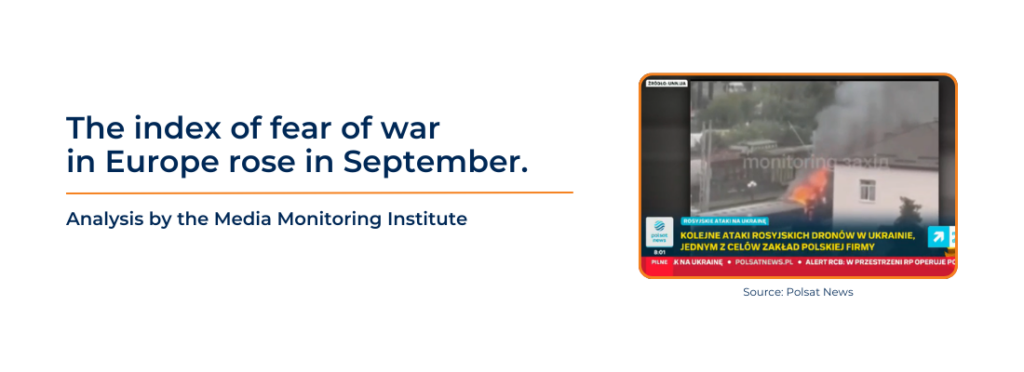
Fear of War in Europe Index at its highest this year after Russian drone strikes a train to Warsaw
On 14 September the Fear of War in Europe Index reached 22.96 points – the highest daily reading so far this year – according to data from the Institute of Media Monitoring (IMM). The spike was triggered by a Russian drone strike on a Kyiv–Warsaw train, first reported in traditional media by Polsat News. Over the two days studied by IMM, the topic generated 28,900 publications in the press, radio, television, online portals and social media.
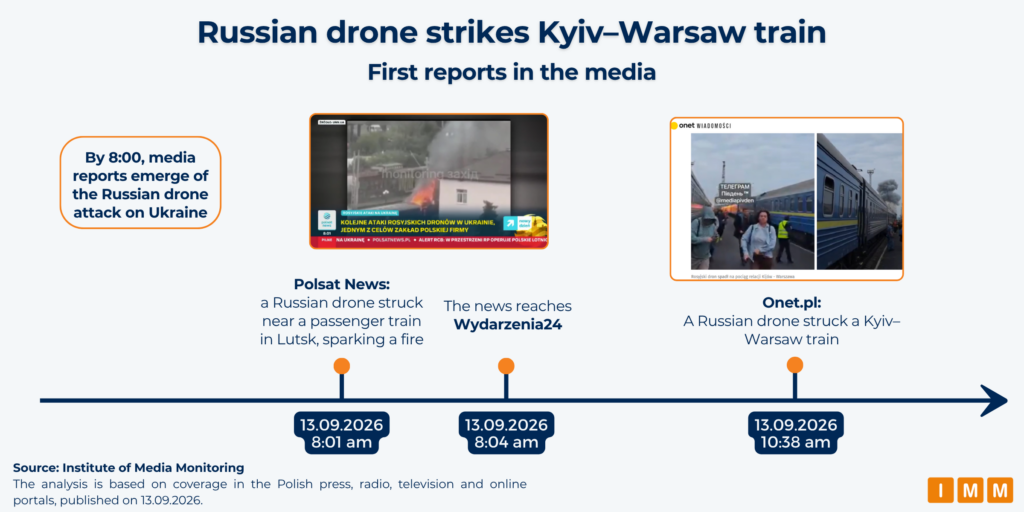
The first media reports of Russian drone attack on Ukraine appeared on Sunday morning, 13 September. At 8:01 am, Polsat News was the first to report that a drone had struck near a passenger train in Lutsk, sparking a fire. At 8:04 am, the news is being broadcast on Wydarzenia24. Then, at 10:38 am, Onet picked up the story, reporting that a Russian drone had struck a Kyiv–Warsaw train.
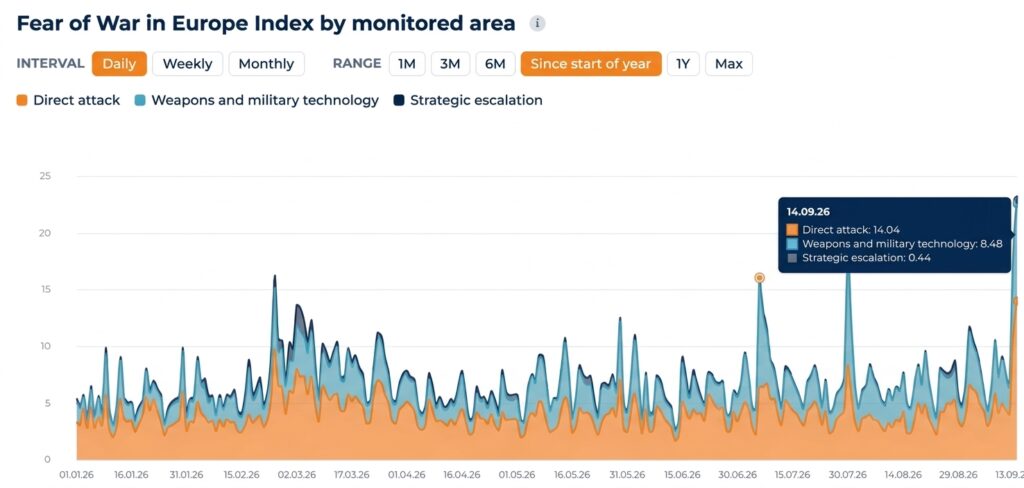
To measure the scale and tone of media coverage of the military threat, IMM developed the Fear of War in Europe Index, which tracks the intensity of public discussion on the topic across social and traditional media in real time. On 14 September, the index recorded its highest reading this year – 22.96 points. The index remains elevated, and its current value can be checked at imm.com.pl/indeksy/en/.
The number of potential contacts with coverage of the topic monitored by IMM reached nearly 807 million – of which 748.2 million came from traditional media and 58.6 million from social media. This translates to an average of 25 contacts with the coverage per statistical recipient in Poland. The strongest showing came from the “direct attack” theme – covering expressions related to direct combat operations, military incidents and rising tension – with a gross reach of 405.5 million. Close behind, with 391 million, was the “weapons and military technology” category, referring to the movement and use of military equipment and armaments. By far the smallest gross reach – 10.4 million – went to “strategic escalation”, which brings together phrases describing the highest level of threat and the risk of military conflict.
In traditional media, the “direct attack” theme was covered most often by TVPinfo (228 publications), while the largest gross reach was generated by TVN24 (58.2 million) and Radio RMF FM (54.5 million). A similar picture emerges in the “weapons and military technology” category – TVPinfo again led in the number of publications (224), while Radio RMF FM (62.6 million) and TVN24 (58.4 million) led in gross reach. “Strategic escalation” was a much smaller-scale topic – the most publications were recorded on Zero TV (10), and the largest gross reach was generated by Newsweek (1.65 million).
On social media, the discussion was dominated by X (Twitter) – it recorded the most mentions across all three categories (1,900 for “direct attack”, 2,500 for “weapons and military technology” and 110 for “strategic escalation”), with Facebook in second place.
Developed by IMM, the Fear of War in Europe Index measures the scale and tone of media coverage of war, threat and escalation. The data comes from continuous monitoring of more than 16 million public Polish social media profiles (X/Twitter, Facebook, Instagram, LinkedIn, YouTube, TikTok) and the full range of sources tracked by IMM in its monitoring of the press, radio, television, online portals, forums and blogs. Each piece of coverage is assigned an index value calculated from the density of keywords in the content, their placement, and gross reach (the estimated number of contacts with the publication). The data is updated around the clock.
The current index reading, methodology and archived data sets are publicly available at: imm.com.pl/indeksy/en/.
Methodology:
The analysis covers coverage in the Polish press, radio, television, online portals and social media published on 13–14 September 2026.
Gross reach refers to potential contacts with a media item. The indicator is developed based on television and radio program viewership/listenership, press readership, the average number of views of online materials – taking into account the exposure coefficient of proper names in the content – and the organic reach of social media channels.