


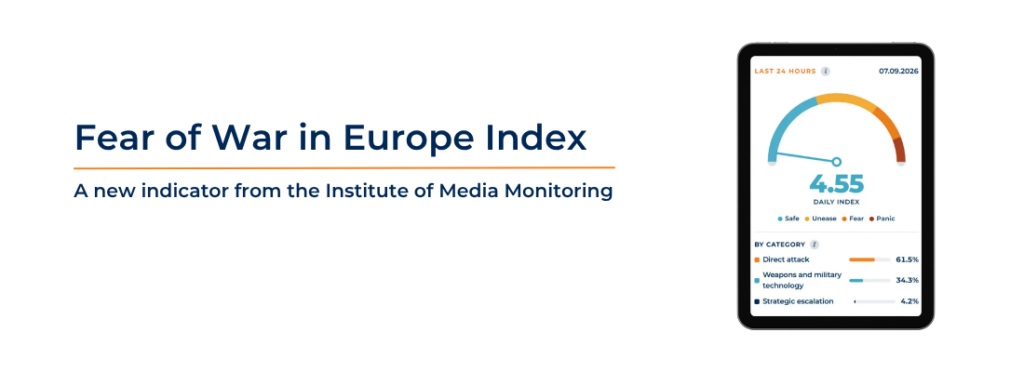
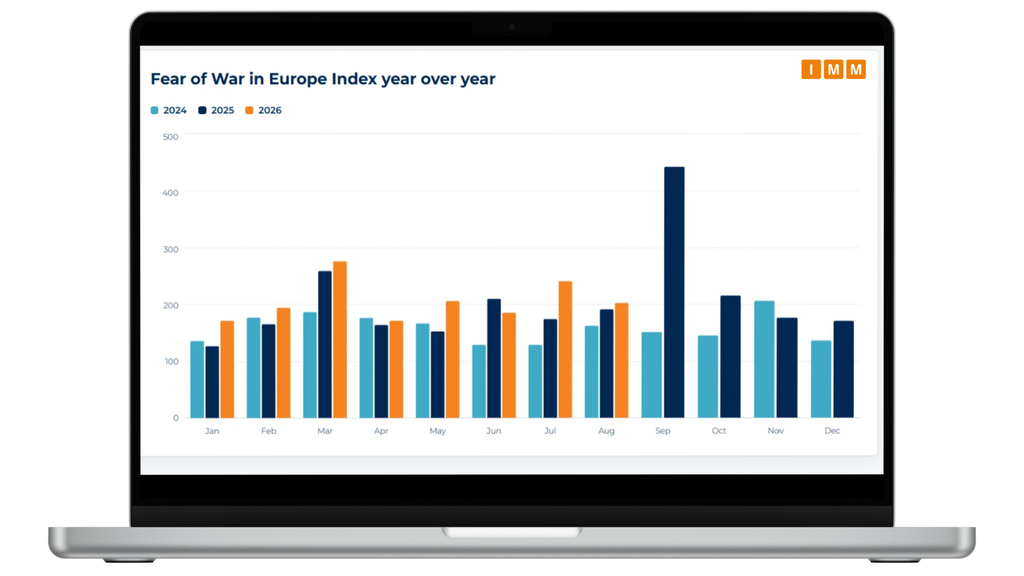
The level of fear of war in Europe in Polish media has risen by 14 percent since the start of the year. Incidents at the Polish border had a direct impact on this spike.
The Institute of Media Monitoring (IMM) has launched the “Fear of War in Europe Index”. This recurring study, based on the monitoring of social and traditional media, tracks in real time the intensity of public discussion about the war in Ukraine, the potential military threat to Poland and a broader risk of conflict escalating in Europe.
The new IMM index measures the scale and tone of media coverage of the war. It is based on the ongoing monitoring of more than 16 million public Polish social media profiles (X/Twitter, Facebook, Instagram, LinkedIn, YouTube, TikTok) and the full range of traditional media (press, radio, television, online portals, forums and blogs). The data behind the index has been aggregated historically since 1 January 2024 and is updated continuously.
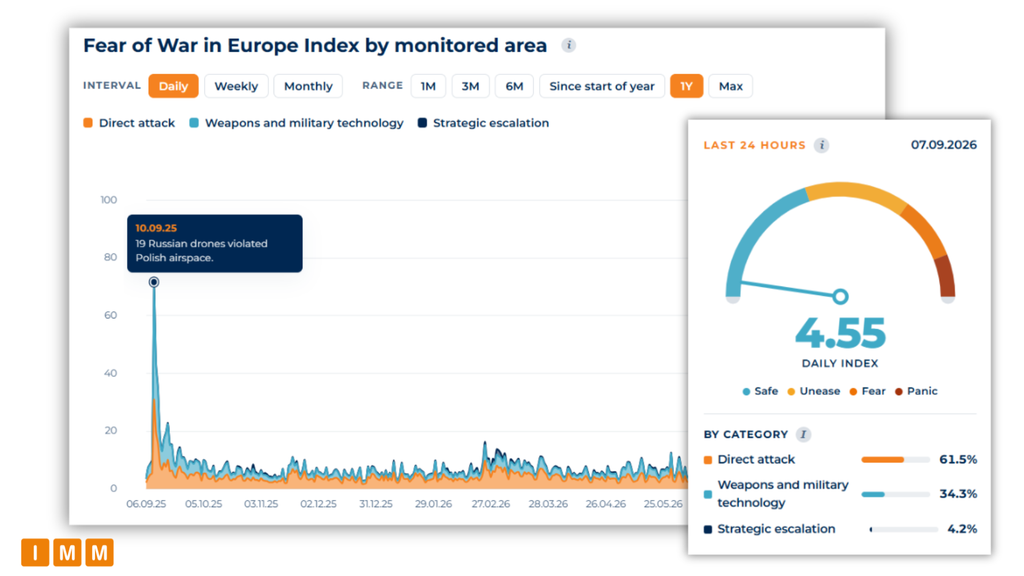
Under the index methodology developed by IMM’s team of experts, every published piece of content about the armed conflict in Europe is assigned a specific index value. The algorithm accounts not only for the density of keywords in the content but also for their placement (e.g. in the headline or in the body) and the total gross reach of the publication. Index readings are updated around the clock every 5 minutes, and the results can be tracked at imm.com.pl/indeksy/en.
“We decided to launch the “Fear of War in Europe Index” because we see how enormous and direct an impact the flow of information about the threat of war has on the public sentiment in Poland. We live in the reality of a hybrid warfare, in which the information has become a strategic weapon. Our goal was to create a reliable indicator based on data aggregated over a long period – one that helps state institutions, businesses and society as a whole understand how sentiment in the media changes over time, and what actually drives a genuine rise in the sense of the threat. Importantly, we study the entire media space, not selected information bubbles. It is classic and social media that are the first source of information for most of us, and they have a direct impact on the overall state of public sentiment”, comments Paweł Sanowski, President of the Management Board of IMM.
Three levels of threat
To pinpoint exactly the nature of fears in the information space, the IMM analysts have grouped the keyword phrases into three main thematic categories. The first is “Direct attack”, covering terms related to direct combat operations, military incidents and rising tension, such as attack, shelling or explosion. The second category is “Weapons and military technology”, referring to the movement and use of military equipment and armaments. The third is “Strategic escalation”, which brings together phrases describing the highest level of threat and the risk of a military conflict.
Border incidents fuelled the debate
The IMM’s data show that between January and August 2026, the “Fear of War in Europe Index” rose by 14% compared with the same period in 2025. Since measurement began, a recurring rise in the index has been recorded around 24 February, on successive anniversaries of the outbreak of the war in Ukraine. Sharp spikes in the index, meanwhile, result from specific events that dominated Poland’s public debate on a given day. Since the start of this year, such growths were recorded after 6 July 2026, when Poland scrambled its fighter jets as a precaution following a massive Russian attack on Ukraine. The second, even more strongly visible in the media and on social media profiles, was 30 July 2026 – the day a Russian missile exploded in the village of Tarnawa-Kolonia in the Lublin region. These two events clearly fuelled the discussion with phrases from the “Direct attack” and “Weapons and military technology” categories.
Since 1 January 2024, the index has reached its highest value (over 70 points on a 100-point daily scale) on 10 September 2025, when 19 Russian drones violated Polish airspace.
Disinformation also exacerbates the fear
IMM experts stress that a higher index reading is not always simply a natural reaction of citizens and the media to specific incidents. Foreign disinformation can play a significant role in driving it up. It is clearly present on social media platforms, and its aim is to stir uncertainty and a sense of threat among Poles in the context of escalating hybrid warfare and forecasts of terrorist or military action.
The current index reading, methodology and archived data sets are publicly available at: imm.com.pl/indeksy/en
The Institute of Media Monitoring consents to the full or partial publication of these materials provided that the source is cited (full name: Institute of Media Monitoring). When using graphics, the source (the name Institute of Media Monitoring or its logo) must be indicated alongside each graphic.