


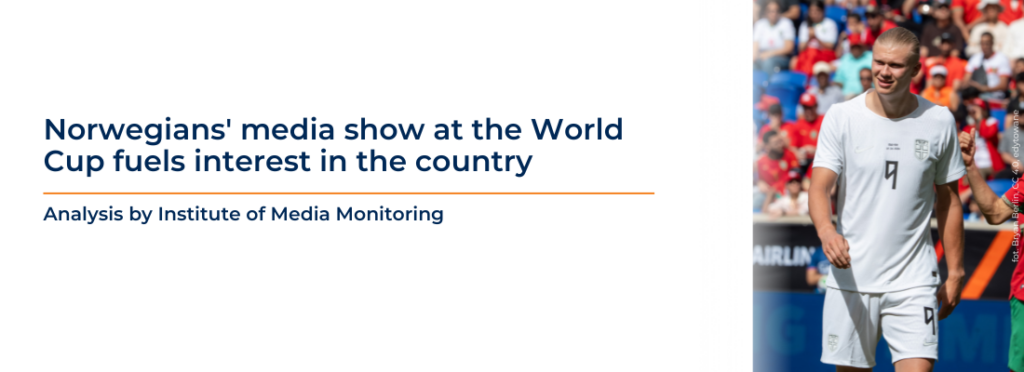
Will tourists flock to Norway? Haaland and the national team’s media attention at the World Cup is fueling the interest in the country
The World Cup once again proved that its impact extends far beyond sports broadcasts. Analysis by the Institute of Media Monitoring (IMM) shows that Norway benefited the most from the image perspective. The entire national team, including its star Erling Haaland, performed extraordinarily on social media, recording the largest increase in the Instagram followers of all participants of the tournament. A unique support of Norwegian fans was also memorable. Simultaneously, Google searches, Wikipedia pages and travel websites all saw a significant increase in the interest in the country itself.
Contemporary World Cup extends far beyond the football pitch. National teams compete not only for football success but also for the attention of global audience. Online reach creates a unique tourism opportunity for countries, directly translating sports excitement into an increased interest in a country as the national brand.

Erling Haaland: natural communication message
During the World Cup, Norway’s biggest star Erling Haaland saw the highest increase in new followers on his Instagram profile among the tournament’s all participants – 31.9 million new followers. This means the Norwegian currently ranks fourth among the most followed active footballers in the world, giving way only to Cristiano Ronaldo, Leo Messi and Kylian Mbappe. According to IMM’s analysis Not only Ronaldo and Messi. Haaland and Vozinha close the World Cup with millions of social media interactions, the Norwegian striker ranked third in terms of the number of fan interactions generated on Instagram throughout the tournament.
This significant increase in followers and engagement was primarily driven by immense virality of the content he had published and his natural communication style. Haaland abandoned rigid messaging in favor of spontaneous forms. He posted behind-the-scenes videos of the team on social media, which quickly went viral and generated millions of views. The fact that the footballer did not take himself too seriously also played a significant role – short videos showing him in everyday situations or during unusual recovery routines were shared on a large scale by TikTok and Instagram users. Going for a relaxed message and showing the athlete’s less formal side perfectly aligned with algorithms that increase the organic reach.
“The increase of almost 32 million followers in such a short period of time mostly results from the Norwegian’s sense of humour and a natural attitude”, comments Tomasz Lubieniecki, Head of Media Reports Department at IMM. “Haaland has shown that modern social media doesn’t require staged marketing sets. Internet users value organic virality, behind-the-scenes insights and a sense of humour. These elements allow short videos to spread rapidly across the Internet, generating spectacular reach”.
Popularity of the Viking Row („Ro!”)
Fans sitting in rows in the stands, imitating the rowing motions of a Viking boat, became one of the most iconic symbols of the tournament, which quickly moved from the stadiums into public spaces. Viral videos of crowds “rowing” on city streets and in public transport were widely shared around the world. The players themselves, including Martin Ødegaard and Erling Haaland, also joined in the post-match celebrations, and videos showing the entire team rowing to the beat of a drum with the fans was one of the most shared videos online.

Source: instagram.com
The cohesiveness of the entire campaign promoting Norway during the sporting event is also noteworthy. The historical motif of a strong warrior, commonly associated with the Vikings, was aptly chosen and attractively exploited. The letters and numbers on the players’ jerseys were stylized as ancient Nordic runes. The colours of the players and fans uniforms were inspired by Norwegian flag, with a strong emphasis on red, which was particularly eye-catching in the stands and in public spaces. The Viking myth naturally connected with Erling Haaland’s appearance and powerful playing style, as well as with the excellent results of the Norwegian national team, which ended the tournament only in the quarterfinals of the World Cup.
Increased interest in Norway
The presence of the national team and its leader in the media has translated not only into social media activity, but also into specific interest in the country itself. The Google Trends analysis shows a clear growth in browsing for “Norway” phrase in the search engine.

Source: trends.google.com
Wikipedia also saw an increased activity – the World Cup surge even surpassed the results from earlier in the year, when the country topped the medal tally at the Winter Olympics in Milan and Cortina d’Ampezzo. The peak search volume (92,500) occurred on 11 July, the day of the quarterfinal match against England.

Source: pageviews.wmcloud.org
The external Airbnb statistics (from 11 June to 12 July 2026) show that Norway is in the top five countries participating in the World Cup with the highest year-on-year increase in unique searches for accommodation, recording a 15% growth.
This trend is also confirmed by the analysis of the Polish market – data from Kiwi.com shows that the average daily number of flight searches from Poland to Norway in the period from 1 to 20 July went up by 32.3% year-on-year.
„We see a clear correlation between the sporting event and the purchasing and travel decisions of its audiences,” adds Tomasz Lubieniecki of IMM. “From the media analytics perspective, it’s crucial that the peaks in search engines and Wikipedia were reflected in Airbnb’s business data and analyses of the Polish tourism market, which noted an increase in interest in Norway during the World Cup. This demonstrates how online virality can build reach with the real value for the image and economy of an entire country. I think that each of us will long remember the swarms of Norwegian fans, dressed in national jerseys, enthusiastically supporting their team in such a unique way.”
Methodology:
The analysis covers social media messages published between 11 June and 19 July 2026.
The Institute of Media Monitoring consents to the publication of all or part of the materials provided that the source is acknowledged (full name: Institute of Media Monitoring). When using graphics, the source (name: Institute of Media Monitoring or logo) must be indicated next to each graphic.