


“Flying Tesla” takes the Polish internet by storm. A wave of Roadster memes floods the web
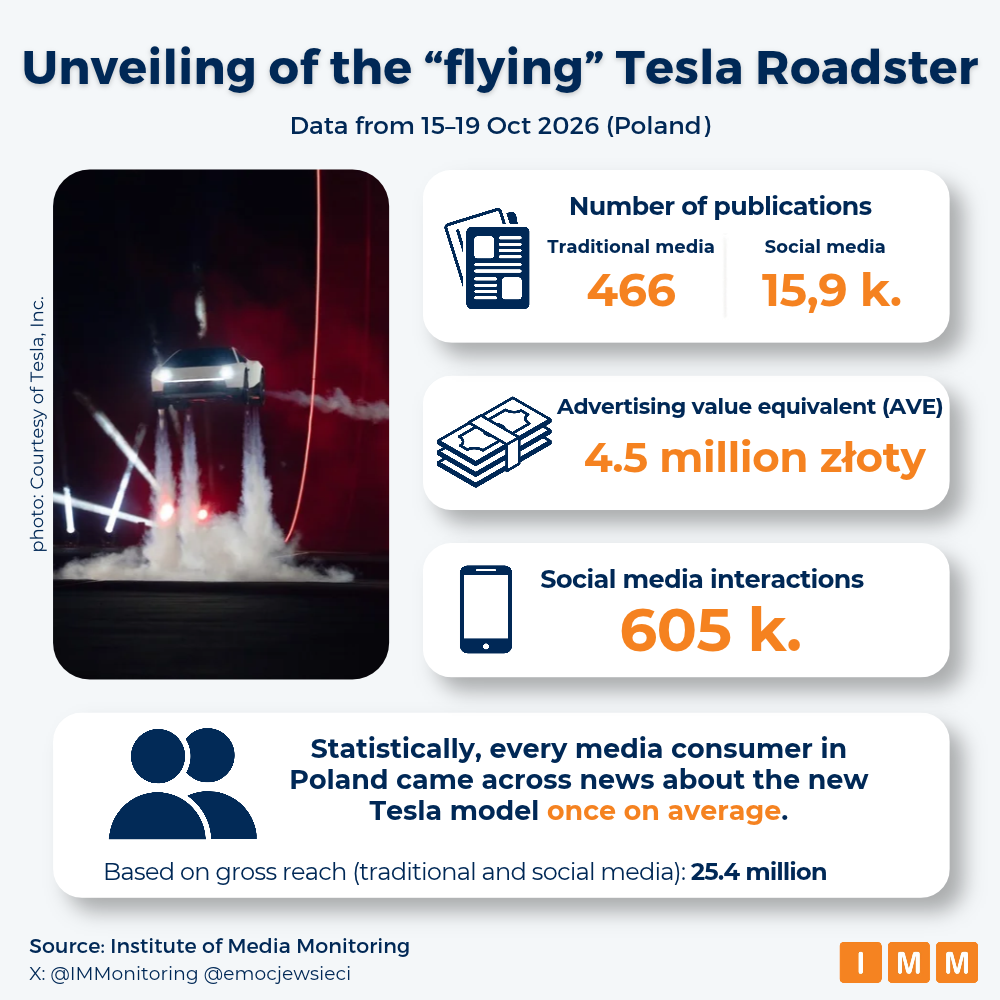
A ramp, a few seconds in the air and a landing – this was the moment that overshadowed everything else at the unveiling of the new Tesla Roadster, held overnight on 15–16 October (Polish time). According to data from the Institute of Media Monitoring, within five days (15–19 October), statistically every media consumer in Poland heard about the “flying Tesla.” Neutral, informational content prevailed online, alongside humor and memes, while among posts expressing a clear opinion, enthusiasm and skepticism were split almost evenly.
Tesla vs. the railroad crossing gates. The new car becomes the star of Polish memes
In the period analyzed, 466 articles about the Roadster appeared in traditional media, while social media users published 15,900 posts and comments. The advertising value equivalent (AVE) of coverage mentioning the new Tesla model reached 4.5 million zloty (estimated based on broadcasters’ and publishers’ net price lists).
Apart from purely informational posts, the online conversation about the Roadster was dominated by memes in which the futuristic show collided with familiar scenes from everyday Polish life. Internet users competed to joke that “we have had flying cars in Poland for ages,” while in the memes the Roadster leapt over railroad crossing gates, ended up in the hands of “Janusz” (the stereotypical Polish everyman of internet humor), hunted for a parking spot outside an apartment block or landed in the world of GTA VI. It was this kind of content that generated the most engagement. Among Polish-language posts, the most interactions went to a video on the TikTok profile @guccifnxd, which generated nearly 173,000 interactions (likes, comments and shares, as of 21 October).
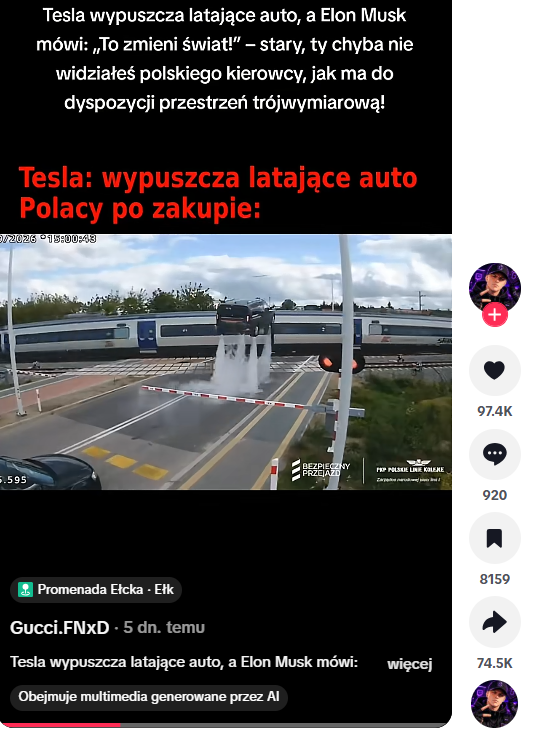
Source: @guccifnxd
The “flying Tesla” steals the spotlight
Flying, flips and thrusters featured in about 70% of social media posts, but several other threads also emerged around the “flying Tesla.” Enthusiasts used the Roadster as an argument in the Europe-versus-USA debate, claiming that the Old Continent “invents nothing” and is busy with “EU tethered bottle caps,” to which others responded by mocking those “dazzled by a flying Tesla.” Roughly one in five posts, in turn, explained the technology behind the show: fans generating negative pressure, cold-gas thrusters and downforce, with authors drawing comparisons to the Brabham BT46B racing car and the McMurtry and Rimac hypercars. There were also more down-to-earth questions – about the EU type approval, insurance, the driving license category required for “flying” and the safety of a 1.5-ton car falling from the sky – as well as remarks that real flying cars are eVTOLs rather than the Roadster. Some users focused on finances, speculating about a Tesla–SpaceX merger and noting that the share price did not rise after the show as much as might have been expected, while others compared the Roadster with the Porsche Mission S, unveiled the same day.
The unveiling of the new Roadster showed just how effectively a sci-fi spectacle can push conventional automotive criteria and years of production delays into the background. Data from the Institute of Media Monitoring shows that online attention was almost entirely captured by a pop-culture sensation – the “flying car” theme, mid-air flips and the defiance of the laws of physics sparked far more interest than the vehicle’s actual market usefulness – says Tomasz Lubieniecki, Head of the Media Reports Department at IMM.
Roadster fans and skeptics almost evenly matched
Among posts expressing a clear opinion, 10.5% were positive and 9.9% negative. Tesla fans were thrilled above all by the spectacle itself: driving upside down, the flip and the landing, stressing that it was a real show and not an AI effect (“physics is just a suggestion,” “straight out of a sci-fi movie”). They also praised the declared performance – 0 to 100 km/h in under one second and charging from 15 to 80% in 10 minutes – as well as the boldness of Elon Musk, who, in their view, is “delivering the future” after years of stagnation.
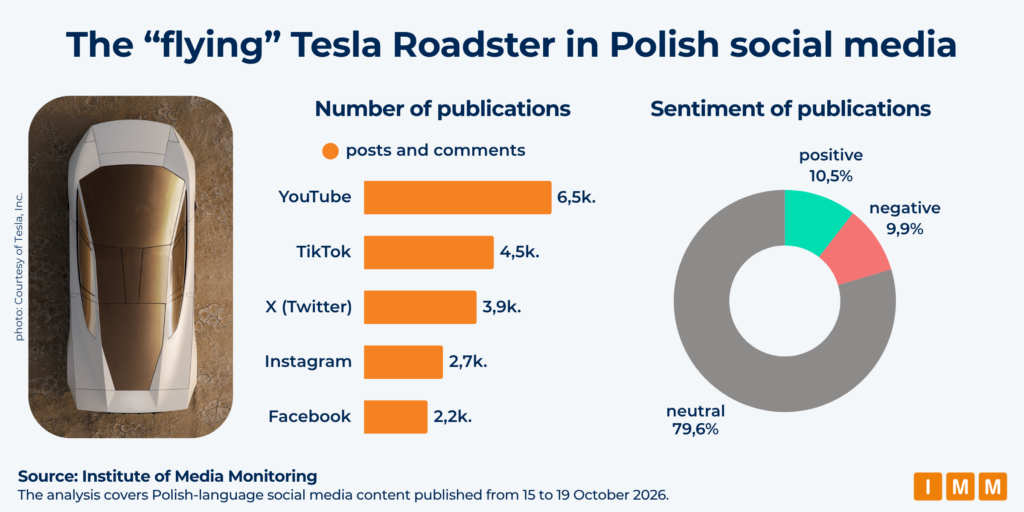
Skeptics, in turn, pointed out that the Roadster was announced in 2017, deliveries were supposed to start in 2020, and now 2028 deadline is mentioned. They criticized deposits with no “delivery guarantee” and the lack of independent performance measurements, accusing Tesla of putting on “a PR show, not automotive engineering” and comparing the Roadster to the Cybertruck or 3D TVs. The most heated debate took place on X, where positive and negative opinions each accounted for about 14% of posts, while YouTube mostly featured skeptical analyses. The criticism did not break through widely, however, as negative posts had limited reach compared with humorous TikTok videos.
Online opinion reveals a clear divide: admiration for Elon Musk’s boldness and the declared performance clashes with skepticism and accusations of yet another delivery delay, the lack of independent measurements, and concerns over type approval and safety. In the end, however, substantive criticism was largely defused by massive reach of entertainment content on TikTok and a wave of Polish memes that turned futuristic promises into a homegrown joke – concludes Tomasz Lubieniecki of IMM.
Methodology:
The analysis covers media items published in the Polish press, radio, television, online news sites and social media from 15 to 19 October 2026. Interaction data as of 21 October 2026.