


Space reach of Nutella during Artemis II mission
The presence of Nutella in the Orion spacecraft cabin has become one of the most widely commented-on elements of Artemis II mission online. The latest analysis by the Institute for Media Monitoring (IMM) shows that on 6-7 April 2026, this topic achieved global reach across digital channels, becoming an example of unique, organic brand exposure in a technological context.
It all started with a live broadcast from aboard the Orion spacecraft, during which viewers spotted a jar of popular hazelnut spread floating in zero gravity. The object, which appeared in frame next to advanced research equipment, immediately caught the attention of internet users. What initially looked like a minor oversight in safety procedures quickly turned into a global trend, sparking a wave of speculation about how the product ended up in such a sterile and restrictive environment.
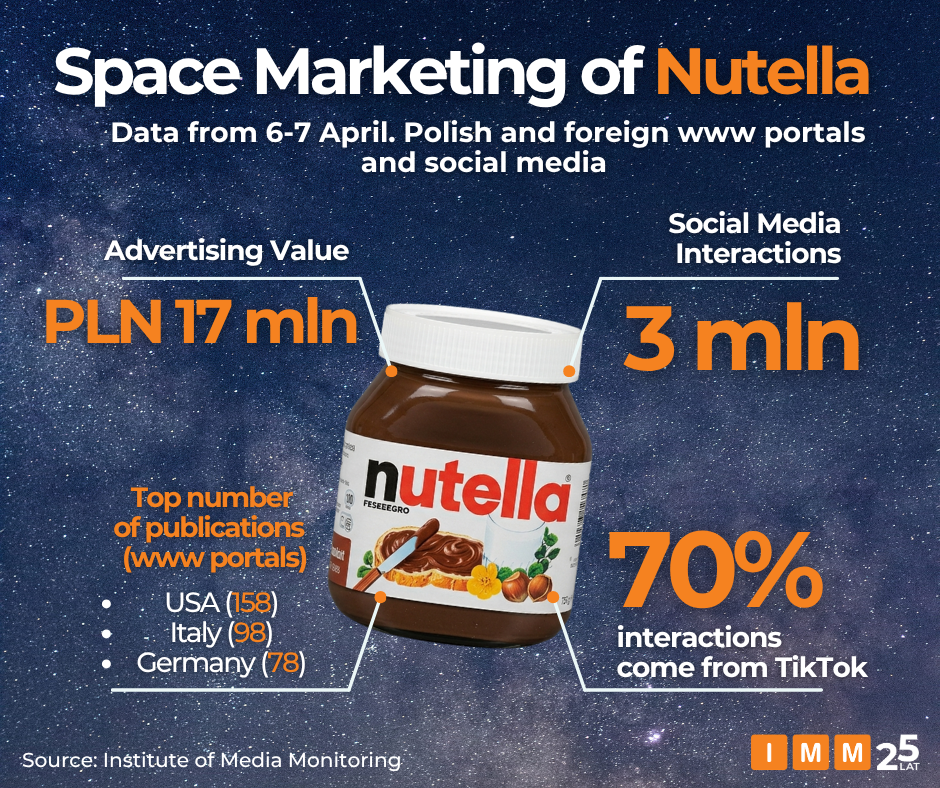
According to the IMM study, in just two days, monitoring of websites and social media recorded a global reach of approximately 108 million potential contacts. The accidental presence of a Ferrero product in space translated into measurable brand benefits – the total advertising value equivalent (AVE) for online and social media publications was estimated at around PLN 17 million.
The power of timing
The main distribution channel for content about the “space Nutella” were social media, where nearly 3 million interactions were recorded. As much as 70% of these were generated by TikTok posts. The platform, built around short-form video, proved ideally suited to the spectacular footage of the drifting jar.
The TOP 3 profiles and channels by total interactions included global publishers CBS News and CNN, as well as the TikTok account TomJerryBomanDickson.
The presence of TomJerryBomanDickson profile in second place is a phenomenon that perfectly illustrates modern dynamics of the internet. We are talking about the profile with only about 900 followers, which outpaced a giant like CNN in terms of interactions. This is proof that in the TikTok ecosystem, the algorithm rewards above all perfect timing, not just an established fan base – emphasizes Tomasz Lubieniecki, Head of the Media Reports Department at IMM.
IMM’s qualitative analysis of social media posts shows that the discussion was driven by strong emotional charge and visual appeal. TikTok and Instagram videos often juxtaposed professional mission footage with humorous music tracks, further boosting their virality. Comments expressing amusement and envy over the “space breakfast” dominated. Social media became a space for creating fan theories and memes that took on a life of their own, independent of the official press coverage.
The world looks up: The US and Italy in the lead
In terms of the number of online publications about Nutella in space, the United States led with 158 articles, followed by Italy – the brand’s country of origin – with 98 publications, ahead of Germany (78), Spain (45) and Mexico (36).
The analysis of content published on websites shows that narrative focused on several key aspects, dominated by surprise and humour, reflected in headlines pointing to the unusual cargo of the Artemis II mission and popular phrases such as “Breakfast in Orbit” and “Space Jar”.
Many internet portals, especially in Germany and the US, took up the question of safety and procedures, investigating how the jar ended up on board and examining NASA’s strict regulations regarding personal items. Italian outlets, meanwhile, focused on the pop-culture symbolism, emphasizing pride in a homegrown product’s presence in such a prestigious context and linking culinary tradition with modern technology. Business and technology portals analysed it mainly in terms of free and remarkably effective product placement.
Nutella in space became the “human face” of technocratic Orion mission, translating into very large organic reach. The whole event seemed so natural and authentic to audiences that NASA itself had to get involved. The agency issued an official statement emphasizing that the jar’s presence was not part of any planned marketing campaign which, paradoxically, only boosted the credibility and viral potential of the event even further – concludes Tomasz Lubieniecki of IMM.
Methodology
The analysis was conducted based on the coverage in Polish and foreign internet portals and on social media, published on 6-7 April 2026. The interaction figures covered 8 April 2026.
Reach indicates the number of potential contacts with a media message. The indicator is developed based on viewership and listenership of radio and TV programmes, press readership and the average number of views of online materials, taking into account the exposure coefficient of proper names in content, as well as the organic reach of social media channels. More information about IMM indicators is available on the website.
The Institute of Media Monitoring grants permission for full or partial publication of these materials on the condition that the source is credited (full name: Instytut Monitorowania Mediów). When using graphics, the source (the name Instytut Monitorowania Mediów or its logo) must be indicated with each graphic.