


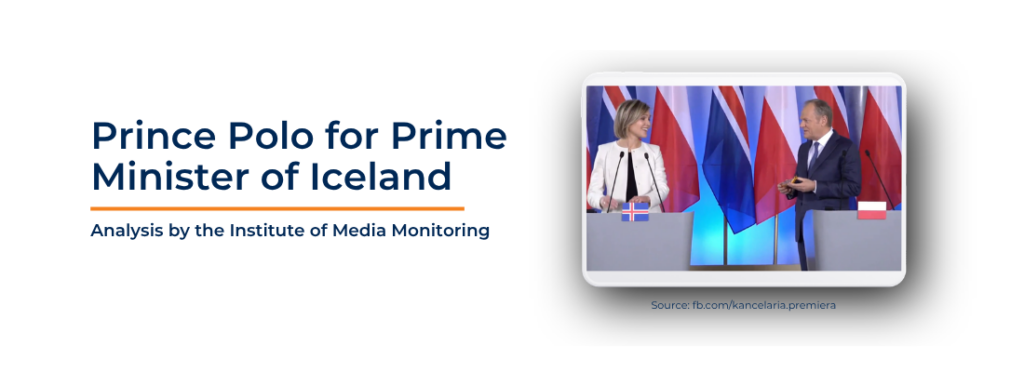
Prime Minister of Iceland “sold” the country to Tusk for a Prince Polo? Emotional debate on Icelandic social media
“Is the European Union trying to buy Icelandic fishing grounds and energy resources with sweets?”, “Kristrún is selling Iceland for an XXL Prince Polo wafer bar,” “One Prince Polo wafer bar and in exchange she wants to hand over control of the country to the EU” – these caustic, irony-laden comments from Icelandic internet users directed at their own prime minister, Kristrún Frostadóttir, show that Donald Tusk’s diplomatic gesture became a flashpoint for an emotional debate about sovereignty in Reykjavík.
At the end of a joint press conference devoted mainly to Iceland’s relations with the EU and the matter of a planned referendum, Prime Minister Donald Tusk presented Prime Minister Kristrún Frostadóttir with a Prince Polo wafer bar. This symbolic gesture referred to the snack’s enormous popularity in Iceland so the Icelandic head of government accepted the gift with enthusiasm.

An analysis by the Institute of Media Monitoring covering the period from 25 February to 1 March 2026, shows that in Poland, Donald Tusk’s gesture generated a reach of 3.6 million potential contacts with coverage in the press, online portals, radio, television and social media, which translated into an advertising value equivalent (AVE) of around PLN 862,000.

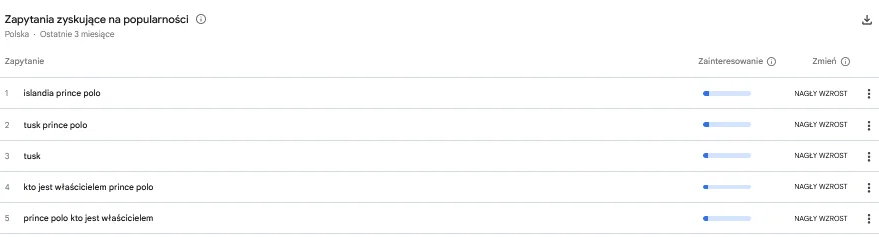
Source: Google Trends
A Polish wafer bar as a campaign tool
It is worth recalling that a Prince Polo wafer bar had already appeared in a public political debate before. At one of his presidential campaign rallies, Rafał Trzaskowski held the popular wafer bar in his hands, citing it alongside other products as an example of Polish export hits and a symbol of the successes of domestic companies abroad – although he himself noted that the plant producing Prince Polo has for years belonged to an American corporation that invests in Poland.
As the IMM experts found, Polish internet users (6,800 posts and comments) reacted to the prime minister’s gesture with a large dose of humour, but also a political mischief. Users noted that Prince Polo is an almost an iconic product in Iceland, recalling that “it’s the only Polish product known in Iceland.”. However, there were also opinions criticizing the prime minister for a PR-driven approach to foreign policy, calling the gesture “wafer diplomacy” or comparing it to “handing out trinkets”.
The fact that Prince Polo has for years no longer been a Polish brand in terms of ownership, but belongs to an international conglomerate Mondelez, was frequently brought up. Comments often raised questions about the point of promoting Poland through a product owned by a global giant, along with bitter remarks about the state of domestic food industry, which – according to some commentators – has become merely a “subcontractor” for foreign capital.
A wafer bar in exchange for sovereignty
In Iceland, the gift from the Polish prime minister was covered by the country’s leading news outlets: visir.is, mbl.is and ruv.is. It was under posts on their social media profiles that heated discussions took place between supporters and opponents of the current prime minister. The most popular video featuring a clip from the press conference, posted on the Facebook page of visir.is generated 136,000 views (as of 3 March). Given the country’s population of around 400,000, this means that this single piece of content alone could have reached one in every three residents of the island.
The main accusations addressed at Kristrún Frostadóttir by internet users – among roughly 800 posts and comments – concerned her alleged wish to bring the country into the EU. Commenters warned that Iceland has “too much to lose” and that joining the community would mean shared agriculture, fishing grounds and energy resources. There were accusations of “selling out the country” and making decisions beyond her social mandate (although in reality the politician had spoken of holding a referendum on the matter).
The iconic status of Prince Polo
As the IMM experts recall, Prince Polo achieved the iconic status in Iceland decades ago, as evidenced, among other things, by a 1981 song by the group Sumargleðin with the telling title “Prins Póló”. The song tells the story of a sailor whose diet, as the lyrics go, is simple: soft drinks and Prince Polo. According to media reports, thanks to trade agreements based on a “fish for sweets” principle, the Polish wafer bar was once almost the only imported luxury available, something older generations of Icelanders still recall today.
Tomasz Lubieniecki, Head of the Media Reports Department at IMM, comments:
The situation in Iceland shows just how deeply rooted the Prince Polo brand is in local identity there, but also how easily it can become hostage to geopolitical tensions. The paradox is that a product, that the Polish internet users identify as part of a global corporation, is still viewed in Iceland through the lens of its historical relationship with Poland. Given the context of the meeting, a seemingly innocent gesture struck a chord with national sovereignty, turning a sweet gift into a bitter topic of debate about natural resources and the country’s future.
Methodology:
The analysis was conducted based on coverage in the Polish press, radio and television, as well as Polish and Icelandic coverage on online portals and social media, published between 25 February and 1 March 2026.
Reach indicates the number of potential contacts with a media item. The indicator is developed based on television and radio program viewership/listenership, press readership, the average number of views of online materials, taking into account the exposure coefficient of proper names in the content, and the organic reach of social media channels. More information about IMM’s indicators is available on the website.
The Institute of Media Monitoring consents to the full or partial publication of these materials on condition that the source is cited (full name: Institute of Media Monitoring / Instytut Monitorowania Mediów). When using graphics, the source (the name Institute of Media Monitoring or its logo) must be indicated alongside each graphic.