


Not just economic advancement. Poland is gaining in the eyes of foreign journalists
The advancement of Poland to sixth place among the European Union economies did not go unnoticed in the foreign media. Within a few days, 143 publications on the subject appeared in 38 countries – according to an analysis by the Institute of Media Monitoring (IMM). The coverage was predominantly positive in tone, emphasizing the pace of modernization and the growing gap between Poland and its regional neighbours. There were also opinions warning of a “paper tiger” hidden behind the good indicators.
According to the latest Eurostat data, Poland’s GDP reached EUR 922.9 billion in 2025, accounting for 4.9% of the total GDP of the European Union countries. This is nearly three times more than the share recorded in 1995 compared to the EU’s current composition (which stood at 1.7% at the time). Last year’s result allowed Poland to overtake the economies of Belgium, Sweden, Ireland and Austria, placing it just behind Germany, France, Italy, Spain and the Netherlands.
Who noticed Poland’s advancement?
During the period of 6-11 August 2026 analysed by IMM, the most coverage of Poland’s economic advancement and results was published on Romanian (21), Serbian (19) and German (15) news portals, with Bulgaria, Bosnia and Herzegovina, Moldova, Spain, Hungary, Italy and Sweden also among the top ten.
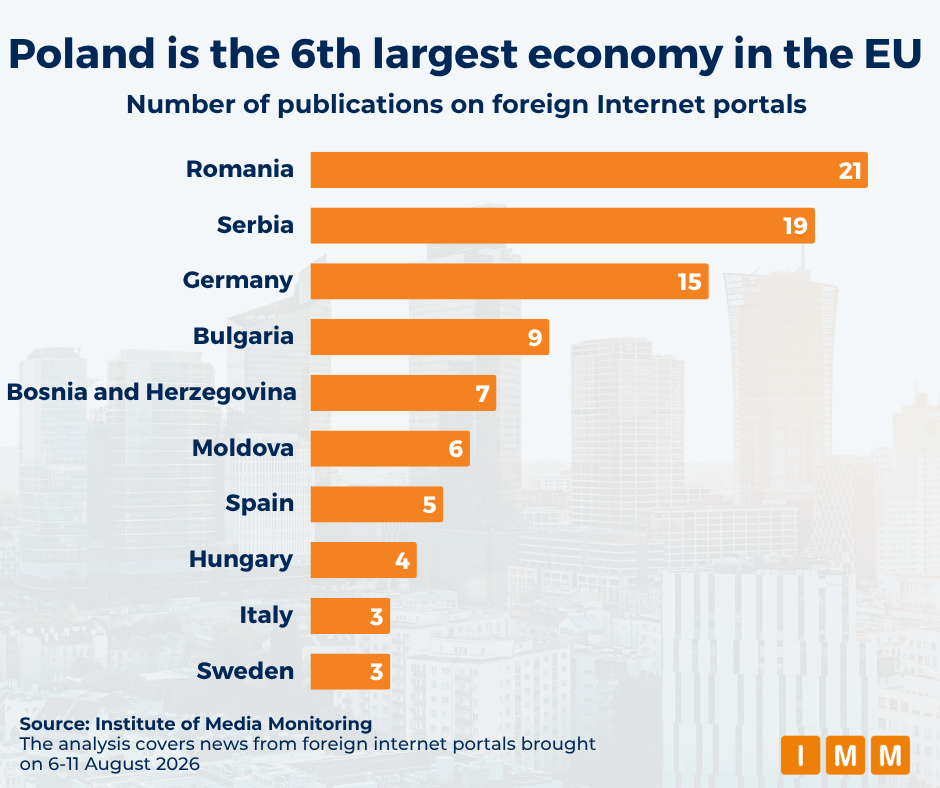
In Southeastern European countries, online journalists emphasized the current gap between Poland and the rest of the region (e.g., naslovi.net). They pointed out that Poland’s economy is more than twice the size of Romania’s, 2.6 times larger than the Czech Republic’s and more than four times larger than Hungary’s. Romanian and Balkan media even presented Poland as a model for infrastructure modernization, citing the expansion of railway stations and the transport network.
During the same period, in Poland the topic of the country’s rise to sixth place among the EU economies was covered by 86 publications on the internet portals, while across all traditional media (press, radio, television and news portals) a total of 273 items were recorded, with a gross reach exceeding 4 million potential contacts. This means that, during the period studied, the information reached only about one in eight statistical recipients in Poland.
Forecasts for the future and a critical perspective
Many reports cited an IMF forecast predicting that by 2028 Poland will overtake Switzerland and join the group of the world’s 20 largest economies, with its GDP surpassing the USD1 trillion threshold. Some commentary suggested that the center of gravity of the European growth is shifting eastward, while Western Europe’s traditional leaders remain stagnant.
Some portals – such as mondo.rs and www.telepolis.de – published analyses tempering this optimism. They pointed to the phenomenon of a “paper tiger” and a two-speed development pattern, highlighting the discrepancy between strong macroeconomic indicators and public sentiment, the cost of living, and budgetary challenges, including high defense spending.
Foreign media focused not only on the indicators of economic success themselves, but also on “how we did it” – the modernization of infrastructure, new roads and railway lines and the digitization of public services. Commentators are also struck by how much the image of Poland diverges from the entrenched narrative of a country still catching up with the West. They write about a clean, safe, and modern country, with cities climbing international rankings – says Tomasz Lubieniecki, Head of the Media Reports Department at IMM.
Foreign internet users delighted with Poland
The experiences of tourists, described on various portals, confirm the reports posted by foreign internet content creators who rave about the cleanliness and level of safety in Polish cities. Under the hashtag #Polandmaxxing, the internet users post photos of modern cities, infrastructure and everyday life, building an image of a country attractive to live in, described as a “high-trust society.”
One of the influencers praising contemporary Poland is Luke Patrick, who has 684,000 followers on Instagram. In his reel featuring a subjective ranking of the best European cities, Luke Patrick placed Warsaw i first place, highlighting its beauty, safety, and cleanliness.
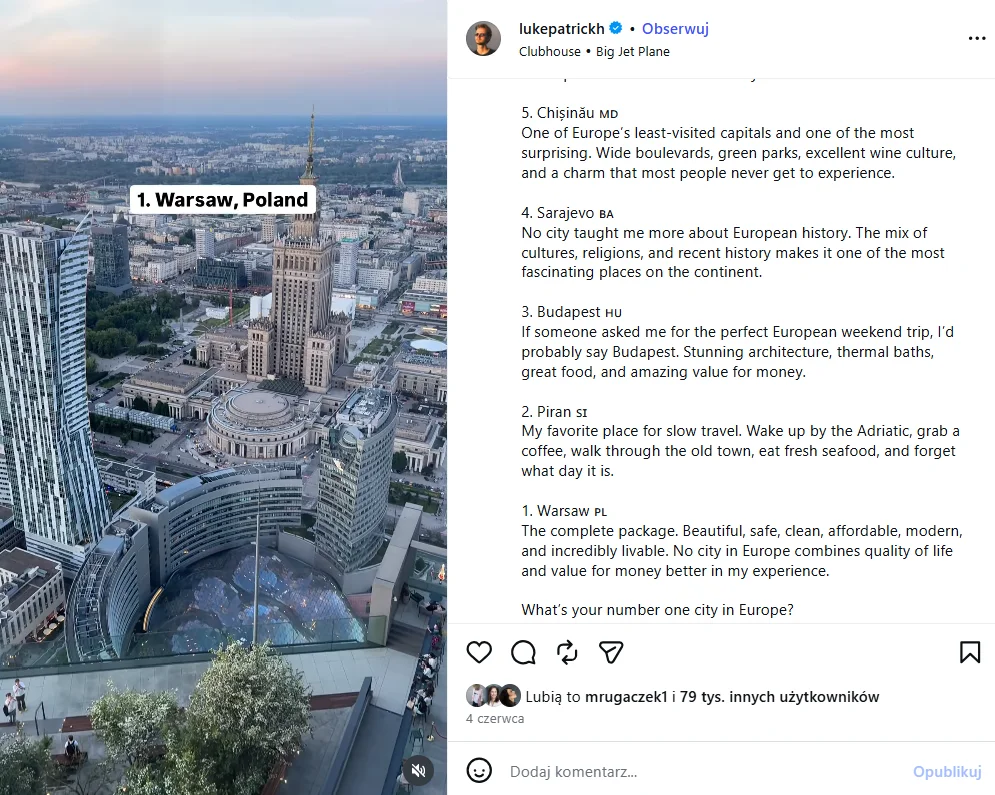
Source: instagram.com
Geopolitics dominates foreign headlines about Poland
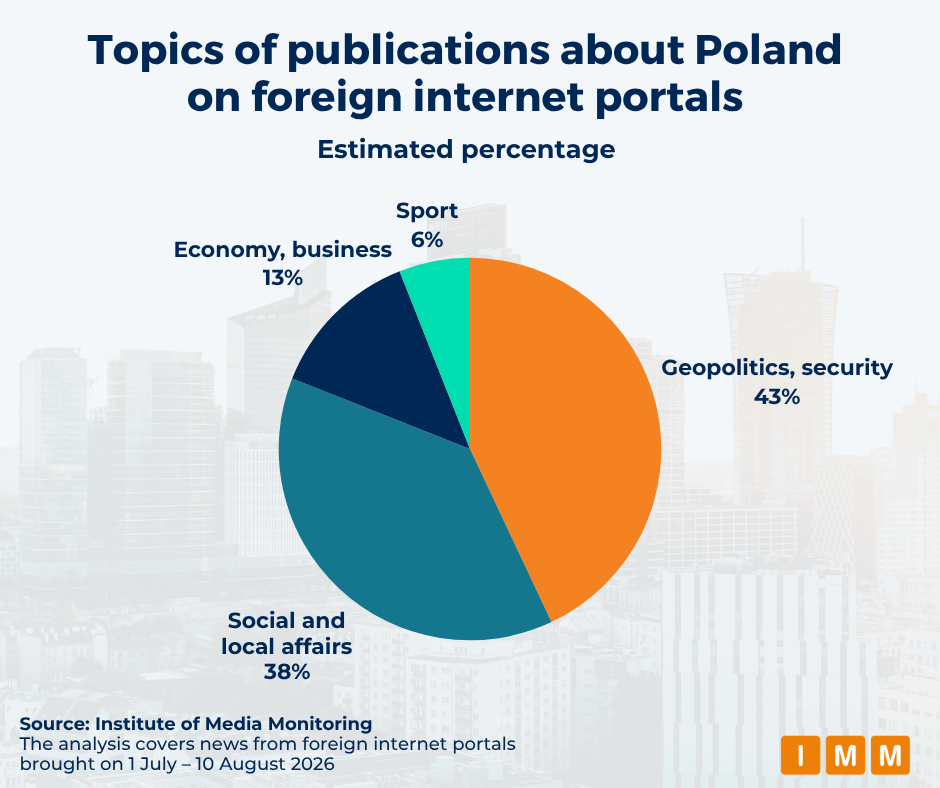
However, the strong condition of Poland’s economy is not the most frequent topic raised by foreign portals in connection with Poland. An analysis of publication headlines from 1 July to 10 August 2026 shows that geopolitical and security-related topics account for nearly half (an estimated 43%) of all coverage of Poland. This category was dominated by the dispute with Ukraine over the National Pantheon and MiG-29 fighter jets, warnings about Russian sabotage and the presence of the US and NATO troops. Social, legal and local matters accounted for about 38%, economy and business for about 13%, and sports for about 6%.
Methodology:
The analysis covers information from Polish and foreign internet portals, as well as the Polish press, radio and television, published on 6-11 August 2026. An additional headline analysis encompasses the coverage of foreign internet portals between 1 July and 10 August 2026.
The Institute of Media Monitoring consents to the full or partial publication of these materials on condition that the source is cited (full name: Institute of Media Monitoring / Instytut Monitorowania Mediów). When using graphics, the source (the name Institute of Media Monitoring or its logo) must be indicated alongside each graphic.