


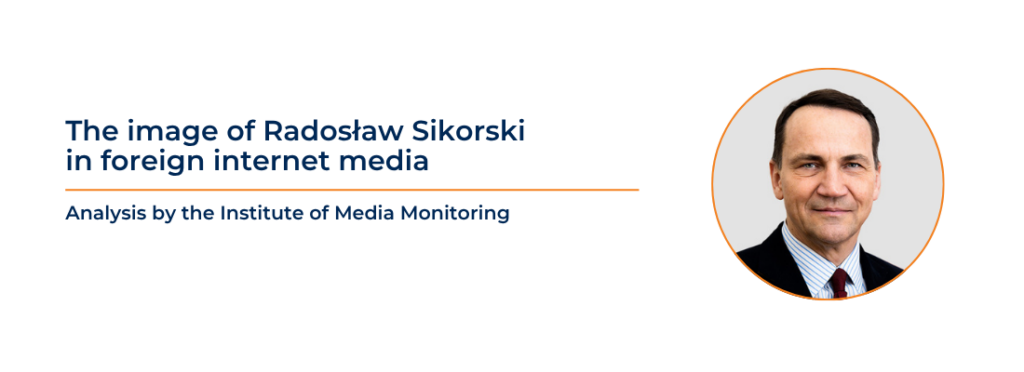
Head of the Ministry of Foreign Affairs in foreign media: strategist in Kyiv, puppet in Moscow
Is Radosław Sikorski an effective architect of the support coalition for Ukraine, or merely a convenient target for media mockery? The latest report by the Institute of Media Monitoring shows that, particularly in the East, Radosław Sikorski evokes extreme emotions: while Ukrainian portals portray him as an effective ally, the Russian propaganda machine consistently builds an image of an “ineffective provocateur”, using invective and techniques of deprecation for this purpose.
The Institute of Media Monitoring examined internet portals from around the world in the period from 1 January to 22 March 2026. A total reach of 213 million potential contacts demonstrates that Radosław Sikorski is currently one of the most media-present politicians from Central and Eastern European region.

Russia and Ukraine in the lead, India also in the top
A ranking of TOP 10 countries where online publications achieved the greatest reach shows that interest in the Polish minister extends beyond Europe. At the top of the ranking, with an almost identical result (approx. 34.5 million in reach), are Russia and Ukraine. Germany’s high position (21 million) stems from the minister’s activity on matters related to historical policy and pressure for arming Ukraine.
India’s fourth position (13.4 million) is the result of a widely reported clash between two differing security doctrines during the minister’s visit to New Delhi. Indian portals intensively explored the subject of “assertive response” of local authorities to Polish appeals concerning Ukraine. In local narrative, Sikorski became the recipient of grievances over Western military support for Pakistan – New Delhi made it clear that their neutrality toward Russia is directly linked to the West’s stance toward their regional rivals.

A clash of two narratives
As part of the study, IMM experts conducted a qualitative analysis of the coverage from two countries with the highest reach. The focus was on a comparison of 20 key sources – 10 most far-reaching and opinion-forming news portals in Russia (fontanka.ru, gazeta.ru, kp.ru, lenta.ru, mk.ru, news.mail.ru, news.rambler.ru, rbc.ru, ria.ru, vz.ru) and Ukraine (24tv.ua, censor.net, epravda.com.ua, korrespondent.net, obozrevatel.com, pravda.com.ua, rbc.ua, suspilne.media, ua.korrespondent.net, unian.ua). The aim of this part of the analysis was to examine how an almost identical scale of reach (approx. 34.5 million contacts in each country) translates into the way Radosław Sikorski’s activities are presented. The study’s results confirm the existence of two opposing narratives.
Ukrainian media build an image of Radosław Sikorski as an effective negotiator and strategist capable of exerting real pressure on global players such as SpaceX. At the same time, the Russian propaganda machine is attempting to discredit these actions. Russian portals consistently repeated the claim that the Polish Ministry of Foreign Affairs’s initiatives are merely “fiction” that in reality does not limit the capabilities of Russian army which, in the eyes of the local audience, is meant to prove Warsaw’s powerlessness in the face of big business and technology – emphasizes Tomasz Lubieniecki, Head of the Media Reports Department at IMM.
IMM’s analysis revealed a deep polarization in the selection of unique topics, issues that are crucial for one side while being completely irrelevant for the other. In Ukrainian media, Radosław Sikorski appears as one of political leaders of Central and Eastern Europe, one who clearly identifies who is the enemy and who is the victim in the ongoing war. An important, indeed existential, issue for Ukraine is the process of integration with the European Union. Ukrainian journalists analyse in detail Sikorski’s “accession realism” and his words spoken during a visit to Kyiv on the fourth anniversary of Russian invasion, that Ukraine “has earned a candidate status to the European Union through its bravery”. These themes, including Ursula von der Leyen’s concept of “reverse membership”, are treated as a priority in Kyiv, while on Russian portals this topic is practically non-existent.
A completely different set of unique topics dominates on Russian sites, which portray Sikorski as an isolated and ineffective politician on the global stage. A powerful narrative tool here has become the incident involving India’s Minister of External Affairs, Subrahmanyam Jaishankar. The RIA Novosti outlet described with satisfaction the public rebuke Jaishankar gave Sikorski, accusing Poland and the West of double standards in their approach to conflicts in Ukraine and Pakistan. In the Russian narrative, this episode is interpreted as a case of Sikorski being “put in his place”.
Russia uses such situations to build an image of Warsaw being sidelined, deliberately omitting substantive issues, such as activity within the EU structures. This is aimed at reinforcing among the internet users the image of Sikorski as a figure lacking any real influence on global politics – notes Tomasz Lubieniecki of IMM.
As the IMM experts point out, Russian portals do not miss the information that strikes at Sikorski in Poland. On 15 January, Gazeta.ru reported in its headline that “Sikorski is paralyzing the country’s diplomatic activity”, citing the words of Marcin Przydacz, Head of the Bureau of International Policy at the Chancellery of the President of the Republic of Poland. He said that in an interview for wPolsce24 station in the context of the absence of Polish ambassadors at several dozen foreign diplomatic posts.
These divergent portrayal of Sikorski lies in a specific descriptive language, which the team of analysts identified as a model of subjectivity in Ukrainian media and a model of deprecation in Russian media. In Ukrainian publications, Sikorski is presented as a politician of subjectivity, expressed through dynamic verbs describing his actions such as “he pushes”, “he coordinates” or “he appeals”, which build an aura of professionalism and effective diplomatic partnership. The situation looks completely different on Russian portals, where the Polish minister often becomes a passive object of mockery and personal attacks. Russian outlets have perfected the technique of “aggression through quotation”, saturating texts with extremely pejorative statements from third parties. This is used by editorial teams to maintain an apparent distance while simultaneously damaging the politician’s image.
A flagship example of this mechanism is the mass repetition, by outlets such as Gazeta.ru, of offensive posts by Elon Musk, who on social media referred to the Polish Minister of Foreign Affairs as a “drooling idiot”. A similar narrative device was used by RIA Novosti portal, which, in building the thesis of Poland’s declining prestige, cited an opinion by Bryan Pilkington. He bluntly called Sikorski a “complete idiot”. Epithets of this kind, alongside recurring terms such as “provocateur” or “puppet,” create a coherent semantic field on Russian portals dominated by notions of scandal, incompetence, and constant conflict, intended to diminish the Polish minister in the eyes of audiences.
According to Anna Nalewajk-Duma, Managing Partner at Clear Communication Group, a member agency of ZFPR:
Currently, Radosław Sikorski is one of the strongest Polish political “export products” possessing a fully developed personal brand, including on a global scale. His key image advantage is his position as an insider. Thanks to his Oxford education and fluency in English, he is perceived by Western elites as a natural member of their own circle.
In his public image, Radosław Sikorski skilfully combines the archetype of the sage with that of a charismatic warrior. The head of the Ministry of Foreign Affairs consciously eschews rounded, diplomatic phrasing and “wooden” diplomatic language in favour of sharp retorts and formats designed for viral reach. He is able to sum up a complex geopolitical strategy in a single, sharp sentence that a journalist is happy to drop into a lead.
It should be noted, however, that due to his tendency toward spontaneous, unfiltered statements, his activity on social media can sometimes be risky. On the other hand, this style allows him to build reach and step outside the so-called “bubble”.
Methodology:
The analysis was conducted based on the coverage on foreign websites published between 1 January and 22 March 2026. The in-depth content analysis examined publications posted on ten Russian portals (fontanka.ru, gazeta.ru, kp.ru, lenta.ru, mk.ru, news.mail.ru, news.rambler.ru, rbc.ru, ria.ru, vz.ru) and Ukrainian portals (24tv.ua, censor.net, epravda.com.ua, korrespondent.net, obozrevatel.com, pravda.com.ua, rbc.ua, suspilne.media, ua.korrespondent.net, unian.ua).
Reach indicates the number of potential contacts with a media item. The indicator is developed based on television and radio program viewership/listenership, press readership, the average number of views of online materials – taking into account the exposure coefficient of proper names in the content – and the organic reach of social media channels. More information about IMM’s indicators is available on the website.
The Institute of Media Monitoring consents to the full or partial publication of these materials on condition that the source is cited (full name: Institute of Media Monitoring / Instytut Monitorowania Mediów). When using graphics, the source (the name Institute of Media Monitoring or its logo) must be indicated alongside each graphic.