



Global success of Polish GameDev. Releases 2025 with hundreds of millions in reach
The Institute of Media Monitoring analysed foreign websites for coverage of Polish video games that debuted in 2025. The study confirms that domestic productions have become one of the most important export goods of Polish digital culture. The leader of the ranking, Dying Light: The Beast, generated a reach exceeding 171 million potential contacts within a month of its release, ahead on the podium of Cronos: The New Dawn and The Alters.
The past year was rich in releases of Polish games eagerly awaited by fans and investors alike. Productions released by studios with an established market position – Techland, Bloober Team, and 11 bit studios – resonated most strongly in the international media space, generating hundreds of millions of contacts with coverage on foreign websites. Journalists from around the world praised, among other things, the atmosphere of Polish games, their mechanics, as well as ethical and historical themes they explore.
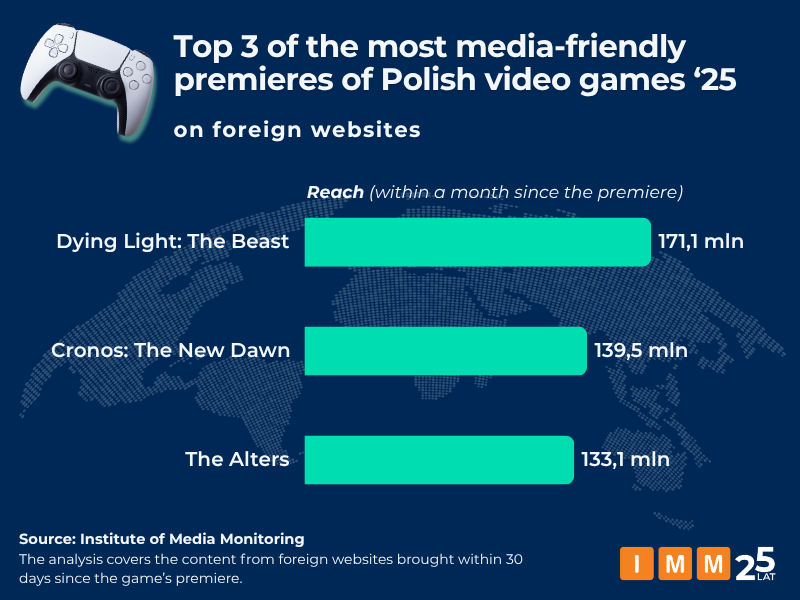
The Institute of Media Monitoring’s analysis focuses on the first month after the release of each title – a decisive moment for shaping opinion among reviewers and players. The greatest reach in this period was achieved by Dying Light: The Beast – 171.1 million potential contacts following its September 18 release. Second place went to Cronos: The New Dawn, which generated 139.5 million in reach after its September 5 debut. Rounding out the podium is The Alters, with a result of 133.1 million following its June 13 release.
What did foreign websites write about?
Based on the content analysis, the IMM analysts identified the most frequently recurring themes that dominated the narrative surrounding the three highest-reaching productions.
- Dying Light: The Beast (Techland): the media was primarily abuzz with the return of an icon – Kyle Crane. Journalists praised Techland for a bold decision to turn the project into a standalone game. The most frequently recurring themes were “a brutal evolution of the hero” and “a new dimension of parkour in Castor Woods.” It was emphasized that the game sets new standards in the action survival horror category.
- Cronos: The New Dawn (Bloober Team): the game gained the greatest publicity thanks to its unique visual style. Media outlets wrote extensively about “1980s Eastern European brutalism” combined with a time-travel theme. Bloober Team was recognized as a master of creating a claustrophobic atmosphere.
- The Alters (11 bit studios): this production became synonymous with “intelligent science fiction.” Media coverage focused on the unique mechanic of managing alternate versions of oneself (the “Jans”). Reviewers analysed ethical dilemmas and psychological depth of survival on a hostile planet, which drew the attention of media outlets not only focused on gaming, but also on popular science.
Polish games eagerly awaited by the US journalists
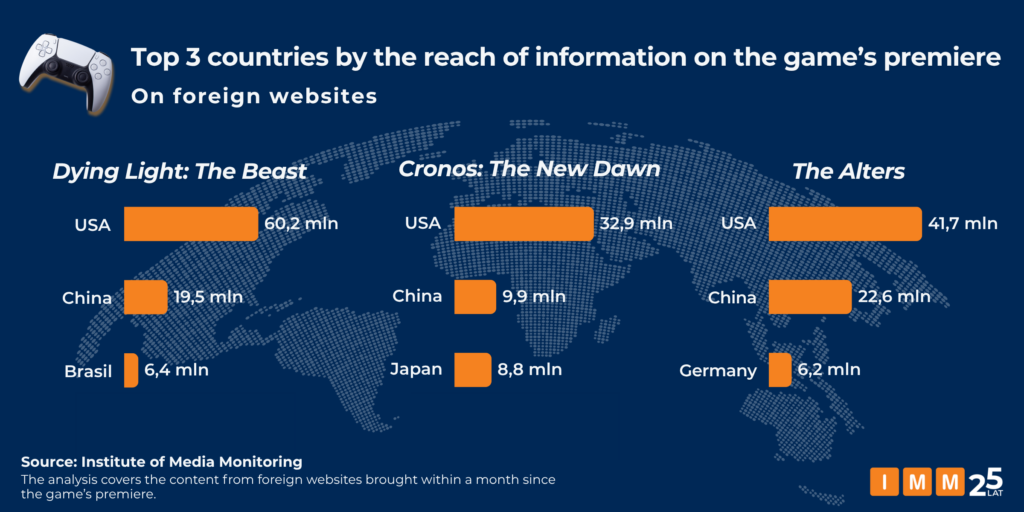
Dying Light: The Beast generated the highest reach on websites from the USA (60.2 million potential contacts), China (19.5 million) and Brazil (6.4 million). Cronos: The New Dawn was also most frequently covered by outlets from the United States (32.9 million) and China (9.9 million), with Japanese-language portals rounding out the podium (8.8 million). In the case of The Alters, the greatest interest was likewise recorded among American and Chinese journalists (41.7 million and 22.6 million contacts, respectively), as well as on German-language portals (6.2 million).
Among the websites the most eager to mention the releases of Polish games were: gamerant.com (27.6 million in reach for content on the TOP 3 titles in the months studied), techradar.com (27.5 million) and ign.com (16.4 million). Somewhat smaller, but still reaching into the millions, were the reach figures generated by: hobbyconsolas.com (9.7 million), 163.com (9.4 million) and pcgamer.com (8.9 million).
Tomasz Lubieniecki, Head of the Media Reports Department at IMM, notes:
Reach figures running into the hundreds of millions are not only the result of the quality of the games themselves, but also of increasingly effective marketing communication, capable of reaching media outlets in the United States, China or Japan.
Foreign editorial teams appreciate Polish creators’ ability to build a coherent, often dark world, refined mechanics and narratives that go beyond light entertainment to carry deeper meaning.
Michał Piątkiewicz, Director, Enterprise Technology & Infrastructure at Burson Poland – a member agency of ZFPR, adds:
Congratulations to teams behind these games. These are great productions, but such impressive visibility results in foreign media are not achieved through a lucky shot. They are the result of years of consistent work by communications teams on relationships with editorial outlets and brand awareness in key markets.
They deserve our support, because video games are today one of the most important vehicles of Polish soft power – it is through them that the world comes to know our imagination, sensibility, and history. This is the only area of culture in which Poland decisively exports more than it imports, so every such release strengthens not only the studio’s sales results, but also the image of Poland’s entire creative economy.
Methodology:
The analysis was conducted based on content on foreign online outlets published within 30 days of each studied game’s release date.
Reach indicates the number of potential contacts with a media item. The indicator is developed based on television and radio program viewership/listenership, press readership, the average number of views of online materials — taking into account the exposure coefficient of proper names in the content — and the organic reach of social media channels. More information about IMM’s indicators is available on the website.
The Institute of Media Monitoring consents to the full or partial publication of these materials on condition that the source is cited (full name: Institute of Media Monitoring / Instytut Monitorowania Mediów). When using graphics, the source (the name Institute of Media Monitoring or its logo) must be indicated alongside each graphic.